Bianca Lorenz · 7 October 2026
Unpacking Semantic Drift Patterns in Collaborative Note Ecosystems Over Time
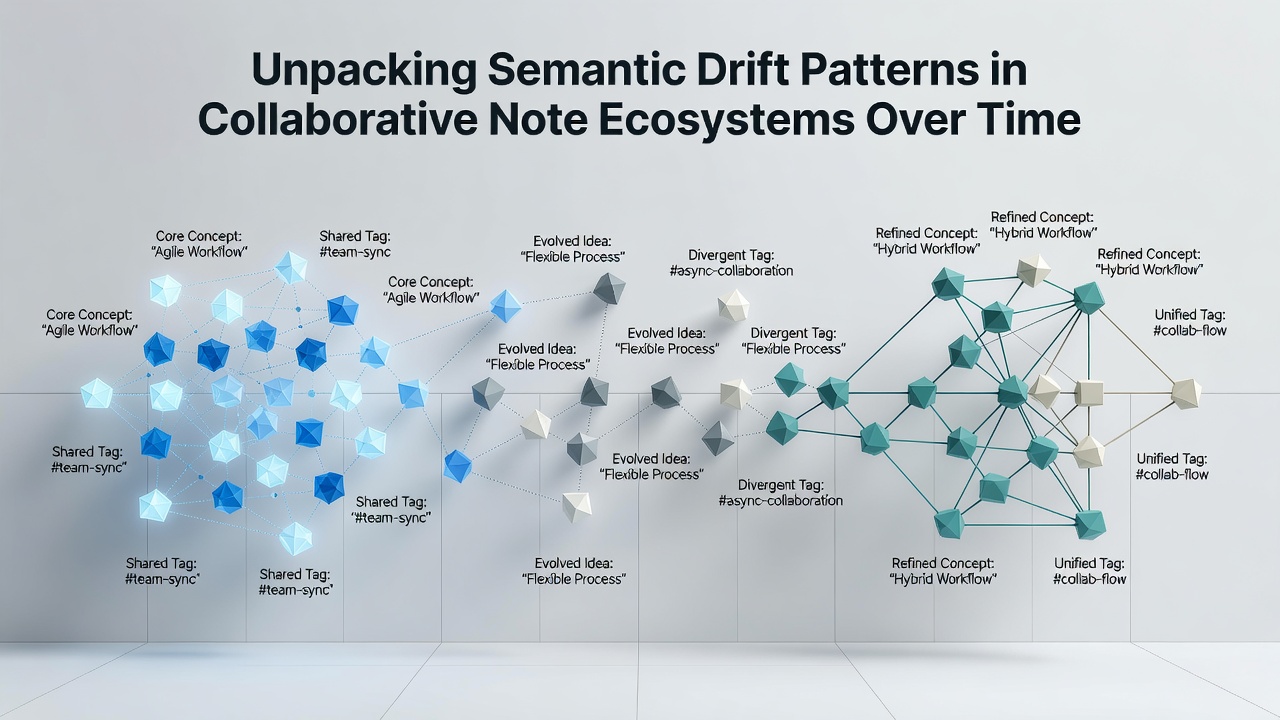
Collaborative note ecosystems consist of shared digital platforms where multiple contributors edit, link, and expand content over extended periods, and semantic drift emerges when the intended meanings of terms, concepts, and connections shift gradually without explicit documentation. Researchers have tracked these changes in systems ranging from enterprise wikis to open-source knowledge bases, and data from longitudinal studies reveal consistent patterns of reinterpretation driven by new contributors, evolving project scopes, and external references that accumulate over months or years.
One pattern involves gradual narrowing of broad initial definitions as teams add specific examples that later users treat as core attributes. Another shows expansion where niche terms absorb related but distinct ideas through repeated cross-references. Studies conducted by academic groups at institutions such as the University of California have quantified these shifts by comparing version histories, and results indicate that drift accelerates in environments with high contributor turnover.
Documented Mechanisms Behind Meaning Shifts
Contributors often introduce context-specific annotations that subsequent editors incorporate into main entries without revisiting original intent. This process creates layered interpretations where early notes retain surface-level consistency while underlying references diverge. Data from platform logs analyzed in 2025 demonstrate that hyperlinks formed during early phases frequently point to sources that themselves undergo updates, compounding the effect across connected pages. Observers note that automated suggestions from search or tagging features further influence these trajectories by surfacing newer content that displaces older framing.
Time-Based Progression Patterns
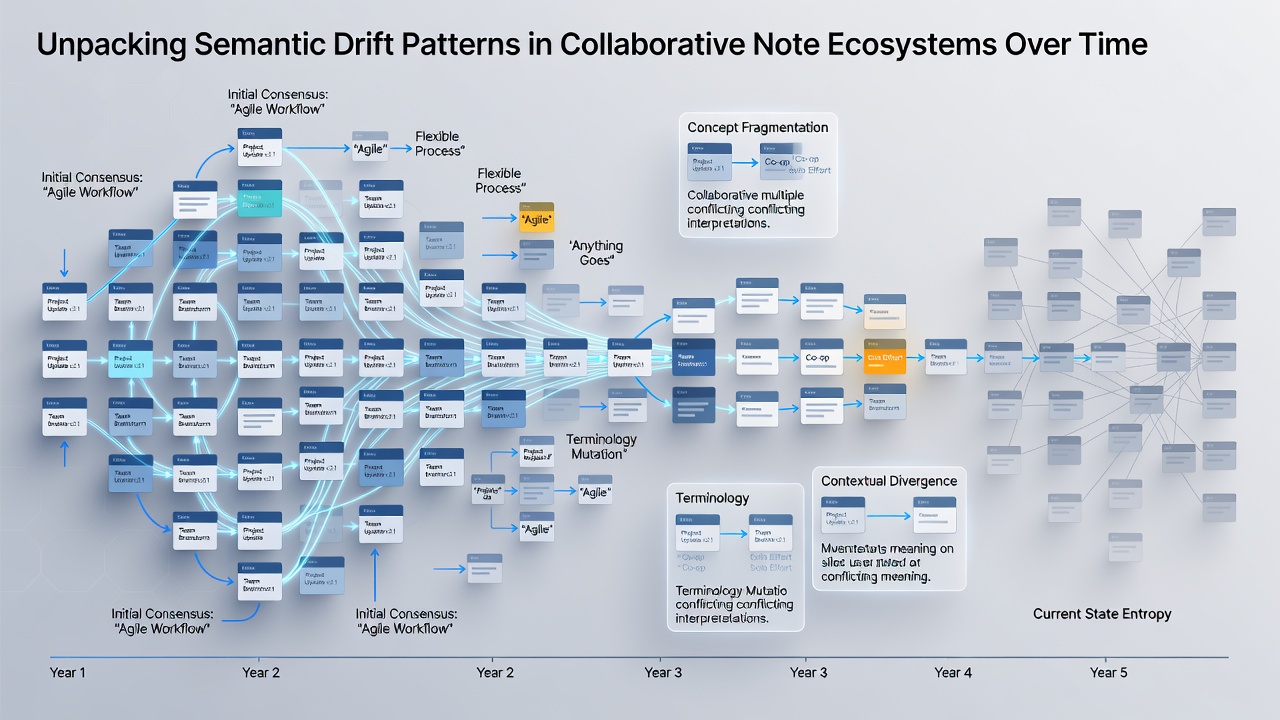
During the first three to six months of a collaborative note collection, semantic stability tends to remain high because founding contributors monitor changes closely. Beyond that window, divergence increases as new participants join and interpret existing structures through their own prior experiences. Analyses covering multi-year spans show that peak drift occurs between eighteen and thirty-six months, after which some stabilization returns when teams establish review protocols. Figures from a 2024 report issued by the National Science Foundation highlight that collections exceeding four years exhibit measurable redefinition in approximately forty percent of core terms.
October 2026 marks a point where several large-scale repositories released updated version archives, allowing researchers to compare semantic states across five-year intervals for the first time at scale. These archives reveal clusters of terms that drifted toward more technical or domain-specific usages while others broadened into umbrella categories. The patterns appear independent of platform type yet correlate with the density of cross-links and the frequency of external citations.
Contributing Factors Identified in Research
High edit velocity correlates with faster drift because rapid additions outpace collective review. Conversely, collections that incorporate periodic reconciliation sessions show slower rates of meaning change. External events also play a role when contributors import terminology from outside sources that carry different connotations. Research teams examining enterprise deployments have found that industry-specific jargon introduced during mergers or acquisitions produces particularly pronounced shifts within internal documentation. Those who have examined open public repositories note parallel effects when news cycles or regulatory updates introduce new framing that editors adopt without explicit discussion.
Metadata such as tags and categories undergo their own parallel drift, often lagging behind content changes and thereby reinforcing outdated associations. Automated indexing tools trained on earlier snapshots can perpetuate these mismatches until retraining occurs. Evidence gathered from multiple platform audits indicates that drift becomes self-reinforcing once enough pages reference the altered interpretations, making reversal more resource-intensive.
Approaches Observed in Practice
Teams addressing semantic drift have implemented version-linked glossaries that record original definitions alongside current usage notes. Others schedule structured audits where contributors map current meanings against historical snapshots. Data from organizations that adopted these methods show reduced divergence in tracked terms compared with control collections. Integration with external knowledge graphs has also been tested as a way to anchor definitions, though success depends on the alignment between the graph's update cadence and the internal editing rhythm.
Platform features that surface conflicting references or highlight terms with high historical edit variance provide additional visibility. Studies published through channels associated with the Association for Computing Machinery describe prototypes that flag potential drift points for human review, and early deployments report improved consistency metrics. These interventions do not eliminate drift but shift its trajectory toward more documented evolution.
Conclusion
Semantic drift in collaborative note ecosystems follows identifiable patterns tied to contributor dynamics, link structures, and temporal accumulation of changes. Research continues to map these processes across diverse deployments, and ongoing archive releases such as those available in October 2026 supply richer datasets for analysis. Organizations and communities that monitor these patterns through structured review and supporting tools maintain greater alignment between original intent and current usage, while those without such measures experience progressive reinterpretation of shared content.