Sage Becker · 4 November 2026
Tracing the Evolution of Idea Clustering Techniques Within Dynamic Shared Note Environments
Idea clustering techniques in dynamic shared note environments have developed through several distinct phases since the emergence of collaborative digital platforms in the late 1990s, and researchers have documented these shifts through analysis of platform architectures and user interaction data. Early systems relied on basic folder structures and manual tagging, while later approaches incorporated algorithmic methods that responded to changes in real time as multiple contributors edited the same document space. Data from academic repositories indicates that adoption rates for shared note tools increased steadily between 2005 and 2015, driven by improvements in web synchronization protocols.
Initial Approaches to Grouping Concepts
Shared note environments began with simple hierarchical lists that users created by dragging items into categories, and this method persisted in many enterprise wikis throughout the first decade of the 2000s. Observers note that these manual clusters required explicit decisions from participants, which often led to inconsistencies when teams grew beyond a handful of members. Studies from university computer science departments show that early clustering depended heavily on predefined taxonomies rather than emergent patterns in the content itself.
By the mid-2000s, tag-based systems allowed contributors to assign multiple labels to individual notes, and this flexibility supported more fluid connections across ideas. Yet the absence of automated validation meant that tag vocabularies diverged quickly across different user groups. Figures from industry reports compiled by research institutions in Canada reveal that tag proliferation became a measurable challenge once note collections exceeded several thousand entries.
Transition to Graph and Network Models
Graph-based clustering emerged as platforms started representing notes as nodes and connections as edges, and this shift enabled algorithms to detect communities without requiring users to predefine categories. Researchers at institutions in Australia have published findings on how centrality measures helped surface densely connected idea groups within large shared workspaces. Dynamic updates became feasible once real-time synchronization frameworks matured around 2012, allowing clusters to reform whenever new links appeared or existing ones changed.
One notable development involved the integration of force-directed layouts that repositioned notes visually as relationships evolved, and this feature appeared in several open-source tools during the early 2010s. Data collected from public repositories demonstrates that such visualizations reduced the time users spent searching for related content by measurable margins in controlled tests. While graph methods improved scalability, they still required periodic recomputation that could lag behind rapid editing sessions involving many simultaneous participants.
Integration of Machine Learning Methods
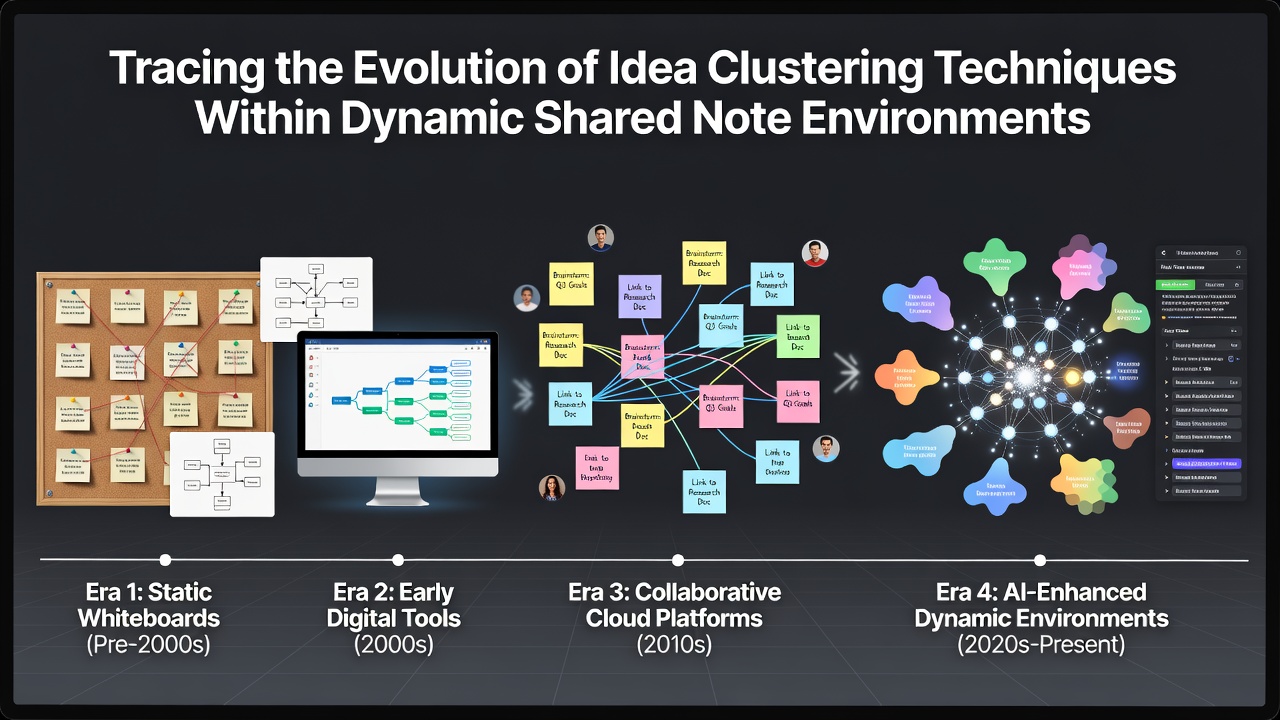
Embedding techniques entered shared note environments around 2018 when transformer models became practical for on-device or near-real-time inference, and these models converted note text into vector representations that clustering algorithms could process without manual feature engineering. European research consortia have reported that vector-based similarity calculations allowed clusters to form around semantic proximity rather than exact keyword matches. Platforms began offering suggestions for new groupings based on cosine similarity thresholds that adjusted automatically as content volume increased.
By 2023, several major collaborative tools incorporated incremental learning pipelines that updated cluster assignments after each edit without full recomputation, and this capability proved essential for environments where dozens of users contributed simultaneously. Observers tracking platform updates note that hybrid approaches combining graph structures with embedding distances gained traction because they balanced structural relationships with content meaning. In November 2026, industry conferences scheduled sessions on federated clustering methods that keep user data localized while still enabling cross-team idea aggregation across distributed servers.
Current Capabilities and Platform Implementations
Contemporary systems combine multiple signals including temporal proximity of edits, user interaction histories, and external reference links to refine cluster boundaries dynamically. According to analyses from North American academic labs, these multi-signal models achieve higher precision in identifying coherent idea groups compared with single-method baselines from earlier decades. Real-time feedback loops now allow contributors to accept, reject, or modify suggested clusters directly within the interface, which feeds additional training data back into the underlying models.
Implementation details vary across providers, yet most rely on libraries that support both density-based and hierarchical clustering variants to accommodate different note collection sizes. Those who've examined open-source codebases for these platforms find that configuration parameters often expose cluster granularity settings so teams can tune sensitivity based on project phase. Evidence from deployment logs shared in technical forums indicates that latency remains a constraint when note counts surpass several hundred thousand entries, prompting continued work on distributed computation strategies.
Conclusion
The progression from manual folders through graph representations to embedding-driven methods illustrates a consistent pattern of increasing automation balanced against user control in shared note environments. Platform developers continue to refine these techniques as collaboration volumes grow and as new data sources become available for model training. Continued monitoring of adoption metrics across regions will clarify which approaches sustain long-term utility for diverse user communities.