
Freya Schulz · 23 September 2026
Decoding User Navigation Flows Within Evolving Knowledge Repositories
Knowledge repositories have grown into complex, living systems where content updates continuously reshape how people locate and traverse information, and researchers track these movements through detailed flow analysis that combines clickstream data with graph-based modeling. Studies from academic institutions reveal that navigation patterns shift when new entries appear or existing ones receive revisions, which forces algorithms to recalculate relevance scores and surface different pathways for subsequent visitors.
Core Components of Navigation Flow Analysis
Analysts break navigation flows into distinct layers that include entry points, intermediate nodes, and exit behaviors, while they measure dwell time at each stage to identify which sections retain attention longest. Data collected across multiple platforms shows that users often enter through search interfaces rather than home pages, and this entry method influences the depth of exploration that follows because initial queries tend to anchor subsequent clicks within related clusters. Graph theory provides the mathematical backbone for mapping these routes, where nodes represent individual articles or documents and edges capture the transitions users make between them, yet the structure evolves whenever editors add cross-references or reorganize categories.
Tracking Changes Over Time
Repositories that update frequently require longitudinal tracking methods so that analysts can compare navigation sequences before and after content modifications, and September 2026 brought platform-wide releases that introduced new versioning tools allowing precise correlation between edits and flow alterations. Those tools record timestamped snapshots of the repository graph, which lets researchers isolate the impact of a single article expansion on traffic distribution across connected pages. Evidence from several institutional deployments indicates that even minor additions to glossary terms can redirect substantial portions of users toward explanatory content, while removal of outdated links reduces dead-end occurrences that previously interrupted sessions.
Heatmap overlays and session replay techniques complement the graph approach by highlighting areas where users pause or backtrack, revealing friction points that static link structures alone cannot explain. When combined with metadata on content freshness, these visualizations help administrators prioritize which sections need reorganization to maintain efficient discovery as the repository expands.
Methods Employed by Research Teams
Teams apply sequence mining algorithms to large-scale logs in order to extract common subsequences that appear across thousands of sessions, and they cluster similar paths to detect behavioral archetypes such as linear readers versus exploratory browsers. Machine learning models trained on these clusters predict likely next steps with increasing accuracy as more data accumulates, yet performance depends on continuous retraining because repository evolution alters the underlying probabilities. One study from the Australian Research Council examined navigation within scientific databases and found that cross-disciplinary links increased the average path length by connecting previously isolated subgraphs, which in turn raised the chance of serendipitous discoveries for users who followed those bridges.
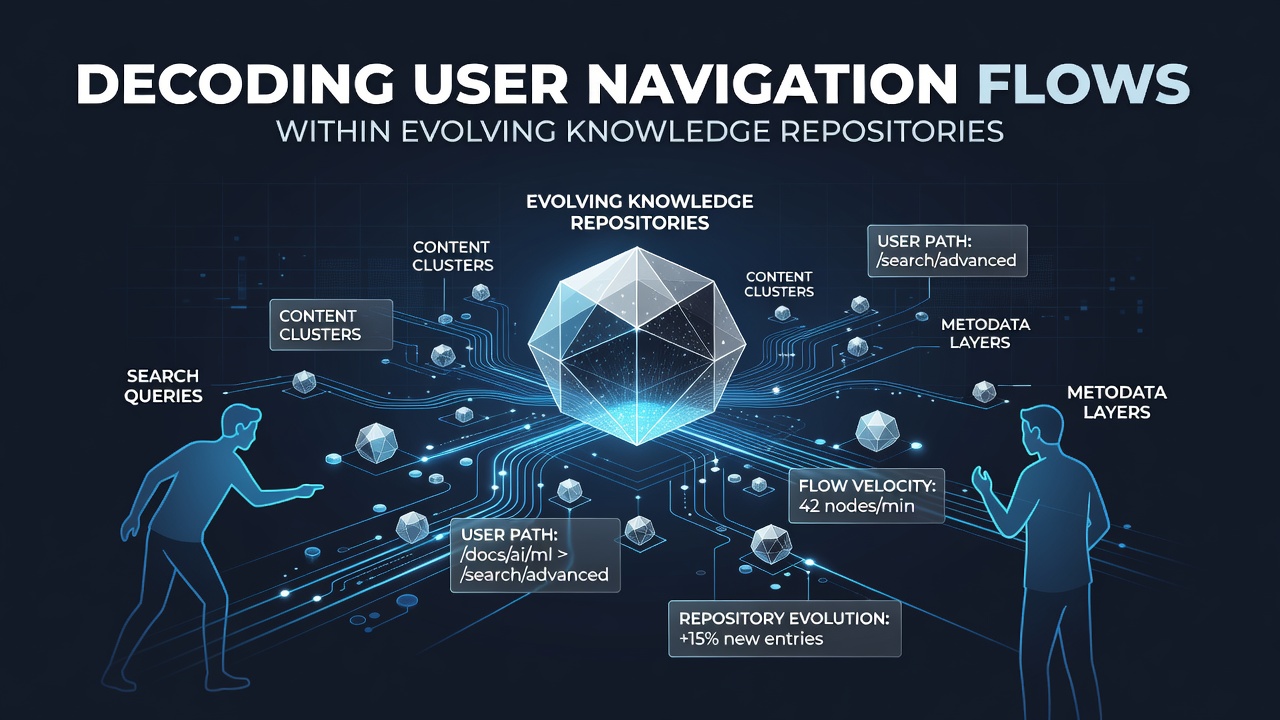
Simulation environments allow testing of hypothetical updates before they go live, and these models incorporate user preference distributions drawn from historical data to forecast how flows might redistribute. Observers note that such simulations reduce the risk of unintended navigation bottlenecks that sometimes emerge after large-scale taxonomy changes.
Integration with Broader Platform Metrics
Navigation flow insights feed directly into content governance decisions because they quantify which topics attract sustained engagement versus those that users skim and abandon, and this information guides editorial priorities without relying on subjective assessments. Platforms that expose aggregated flow statistics to contributors enable more informed link placement, while privacy-preserving aggregation techniques ensure individual sessions remain untraceable. Reports from the National Science Foundation highlight how shared repositories across research consortia benefit when flow data informs collaborative editing workflows, resulting in tighter integration between related projects that previously existed in isolation.
Real-time dashboards now surface emerging patterns within hours rather than weeks, which gives administrators the ability to respond quickly when sudden spikes in certain routes signal either heightened interest or potential confusion caused by recent edits. These capabilities rely on streaming data pipelines that process events as they occur and update flow models incrementally instead of requiring full recomputation each cycle.
Conclusion
Decoding navigation flows inside evolving knowledge repositories demands continuous adaptation of analytical techniques to match the pace of content change, and the combination of graph analysis, sequence mining, and temporal tracking supplies the necessary visibility. Organizations that implement these approaches gain measurable improvements in how effectively users locate relevant material even as the underlying structures shift, and ongoing research continues to refine the precision of predictive models that anticipate future navigation behaviors based on past patterns and planned updates.